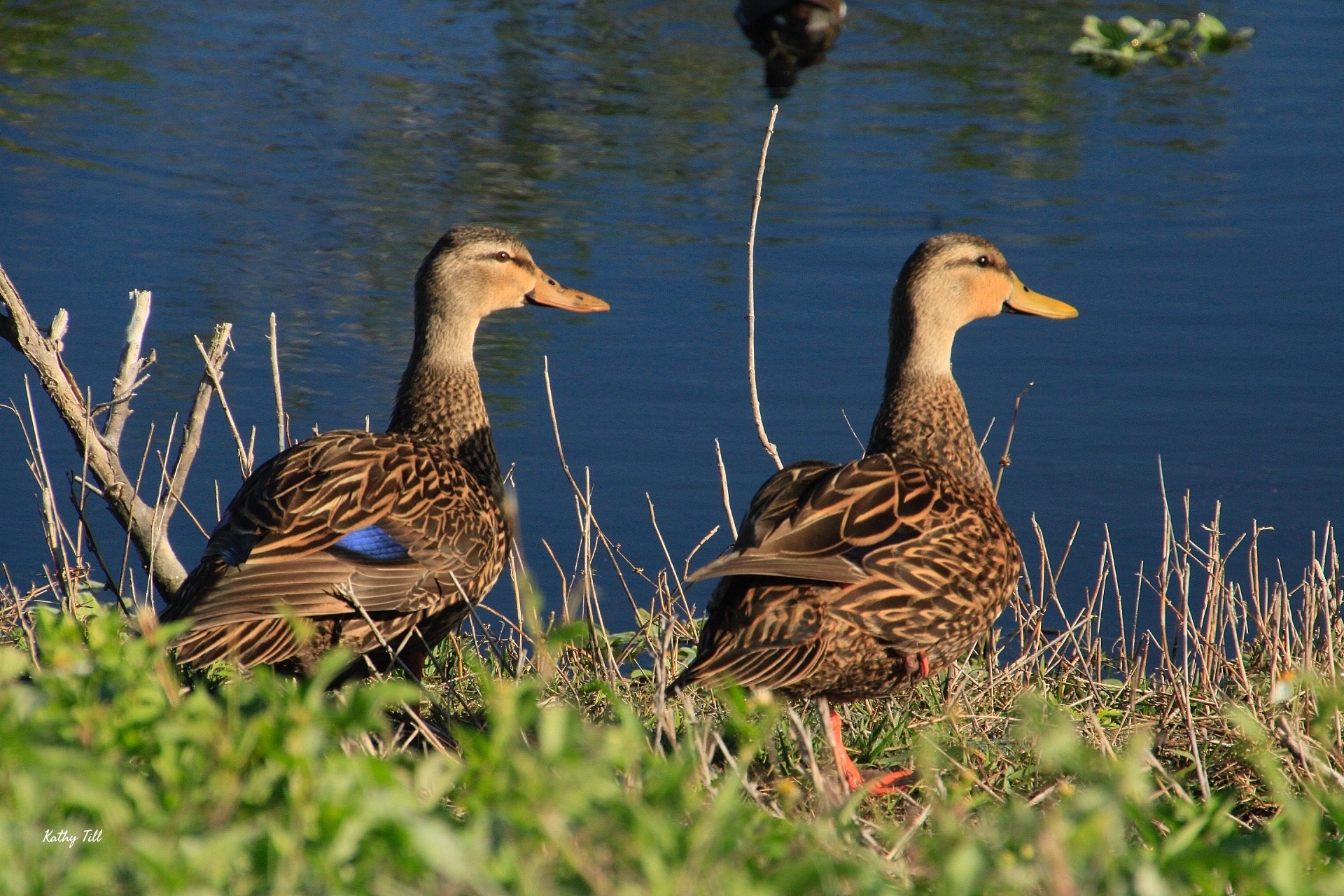


Meet the Ducks
We’re heading back down to the water in today’s edition of Bird Bonanza to meet the ducks. From the familiar Mallard to the migrating Black Bellied Whistling Duck, Blue Winged Teal and Mottled Duck. Striking colors that shimmer in the sun when wet, all of these agile swimmers are a joy to watch and photograph.
The Mallard
- If someone at a park is feeding bread to ducks, chances are there are Mallards in the fray. Perhaps the most familiar of all ducks, Mallards occur throughout North America and Eurasia in ponds and parks as well as wilder wetlands and estuaries. The male’s gleaming green head, gray flanks, and black tail-curl arguably make it the most easily identified duck. Mallards have long been hunted for the table, and almost all domestic ducks come from this species.
- The widespread Mallard has given rise to a number of populations around the world that have changed enough that they are considered separate species. The Mexican Duck of central Mexico and the extreme southwestern United States and the Hawaiian Duck both are closely related to the Mallard, and in both forms the male is dull like the female. Both have been given full species status.
- Ducks are strong fliers; migrating flocks of Mallards have been estimated traveling at 55 miles per hour.
- The standard duck’s quack is the sound of a female Mallard. Males don’t quack; they make a quieter, rasping sound.
- The oldest known Mallard was a male, and at least 27 years, 7 months old when he was shot in Arkansas in 2008. He had been banded in Louisiana in 1981.
The Black-Bellied Whistling-Duck
- The Black-bellied Whistling-Duck is a boisterous duck with a brilliant pink bill and an unusual, long-legged silhouette. In places like Texas and Louisiana, watch for noisy flocks of these gaudy ducks dropping into fields to forage on seeds, or loafing on golf course ponds. Listen for them, too—these ducks really do have a whistle for their call. Common south of the U.S., Black-bellied Whistling-Ducks occur in several southern states and are expanding northward.
- The oldest recorded Black-bellied Whistling Duck was a male, and at least 10 years, 7 months when it was found in 2015 in Louisiana. It was originally banded there in 2005.
The Blue Winged Teal
- Pairs and small groups of this tiny dabbling duck inhabit shallow ponds and wetlands across much of North America. Blue-winged Teal are long distance migrants, with some birds heading all the way to South America for the winter. Therefore, they take off early on spring and fall migration, leaving their breeding grounds in the United States and Canada well before other species in the fall.
- The Blue-winged Teal migrates over long distances. One individual banded in Alberta was shot in Venezuela a month later.
- The oldest recorded Blue-winged Teal was a male, and at least 23 years, 3 months old. He was originally banded in Saskatchewan and was found shot in Cuba in 2005.
Mottled Duck
- Mottled Ducks are fairly common within their limited range. Almost any freshwater wetland can provide nesting habitat for a pair, including marshes, ponds, ditches, and impoundments. In Florida, hybridization with introduced Mallards has produced many so-called “Muddled Ducks,” and care is needed to confirm identification of a “pure” Mottled Duck.
- Mottled Ducks form pair bonds even earlier than most other ducks—typically by November before the breeding season starts the following spring. In many dabbling duck species, the pair splits up as soon as the female lays eggs, but male Mottled Ducks tend to remain with their mate well into the incubation period and sometimes later.
- The oldest recorded Mottled Duck was at least 13 years, 7 months old when he was shot in Florida, the same state where he had been banded.






Leave a Reply