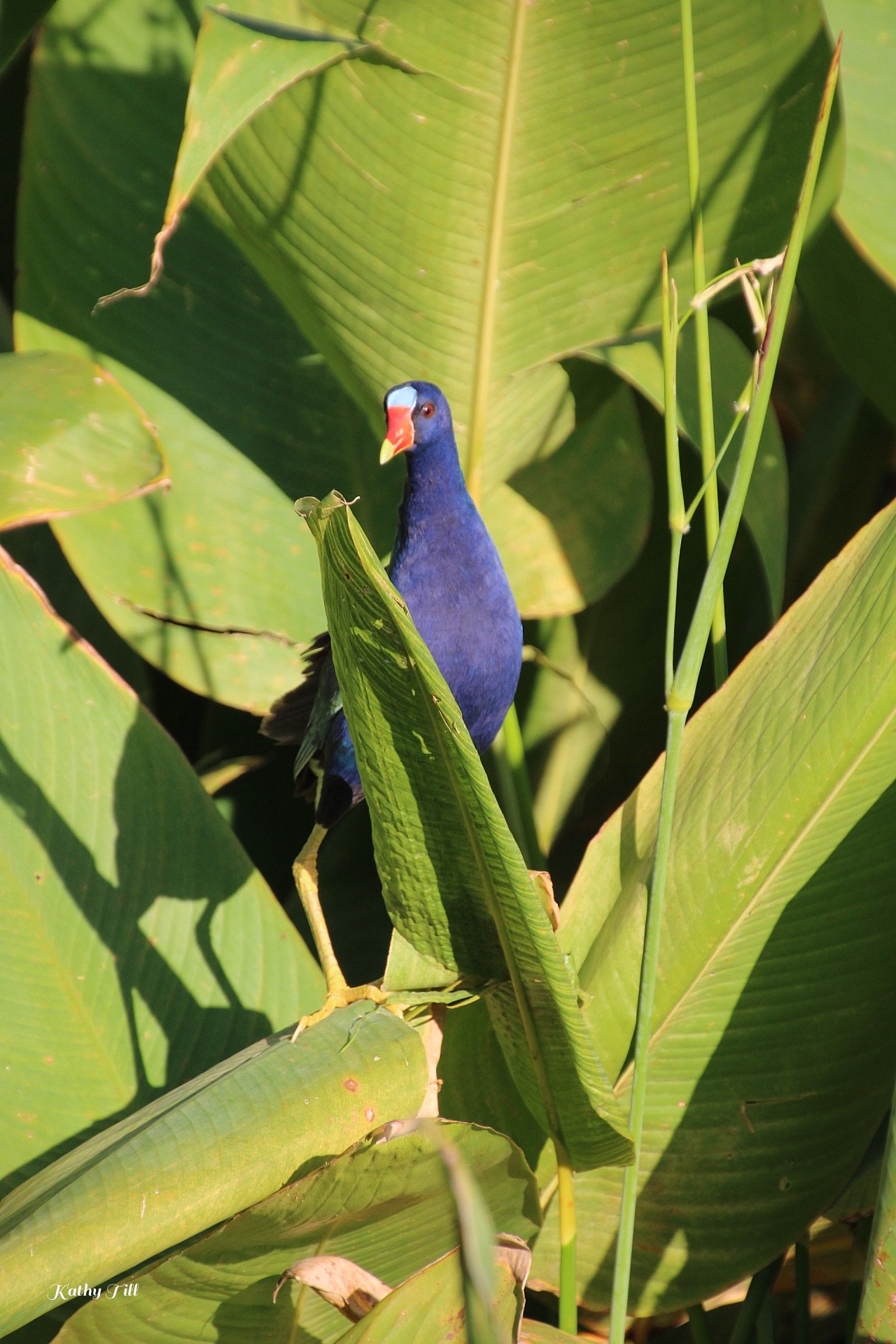


Today we’re taking a deeper dive into the Purple Gallinule. The photos above represent both adult (dark color) and juvenile birds. I find one of their most fascinating features to be the size of their feet in comparison to the rest of their bodies…they are huge! But why? Let’s find out.
“Lurking in the marshes of the extreme southeastern U.S. lives one of the most vividly colored birds in all of North America. Purple Gallinules combine cherry red, sky blue, moss green, aquamarine, indigo, violet, and school-bus yellow, a color palette that blends surprisingly well with tropical and subtropical wetlands. Watch for these long-legged, long-toed birds stepping gingerly across water lilies and other floating vegetation as they hunt frogs and invertebrates or pick at tubers.”
Did you know…
- Purple Gallinules are remarkable fliers and turn up far out of their normal range, surprisingly often. They’ve even shown up in Iceland, Switzerland, South Georgia island, the Galápagos, and South Africa. A recent study noted that these may not be mere accidents: years with severe drought in the gallinule’s core range tended to produce more so-called vagrants in autumn and winter. In other words, these wanderers may not be lost but perhaps seeking places to feed because their usual haunts do not have adequate food.
- Their long toes help them grab onto stems of marsh plants and walk on top of floating vegetation.
- Purple Gallinule chicks are “subprecocial,” meaning they can walk around soon after hatching but cannot feed themselves for the first few weeks of life. The chicks are equipped with a tiny claw at the end of their pollex (innermost digit, corresponding to a human thumb), which helps them grip vegetation as they move around their environment.
- The oldest recorded Purple Gallinule was at least 7 years, 4 months old when it was found in Florida in 1956 where it was originally banded in 1950.
These extremely colorful birds are not only fascinating to observe, but a delight to photograph. We are so lucky that they call Florida one of their homes. To read the facts above learn much more about the Purple Gallinule, be sure to visit the Cornell University Lab of Ornithology website.






Leave a Reply